
In today’s fast-paced world, finding sustainable and cost-effective transportation options is vital. However, as our lives get busier, we often forget to consider the impact of our transportation choices on the environment, our health, and our communities. At the airline, and our parent brand Oxford Bus Company, we are dedicated to enhancing these benefits and ensuring we have a positive impact far beyond getting people from point A to point B. Read on to discover why you should consider hopping on a bus or coach for your next journey…
Environmental benefits
Reduced emissions and cleaner air
According to the Royal College of Physicians, around 30,000 deaths per year in the UK are linked to harmful vehicle emissions such as carbon monoxide (CO), carbon dioxide (CO2), and nitrogen oxides (NOx). Although all buses in Oxfordshire meet the Euro V emissions rating which regulates the emission of these harmful by-products, the majority of the Oxford Bus Company fleet adheres to the more stringent Euro VI emissions standards. In fact, our average Oxford bus emits 23% less carbon emissions per kilometre than the average UK bus. This is largely because we have one of the highest percentages of electric-hybrid buses in a UK bus fleet. Plus, with Oxford Bus Company’s pivotal role in the recently signed deal to bring 159 electric buses to Oxfordshire, the environmental benefits of bus travel are likely to improve even further. In 2026, we also introduced 13 brand-new coaches for airline services. The coaches are ultra-low Euro 6 rated for emissions, so you’re not only travelling in comfort, but your journey is greener too!
Low carbon footprint
Taking a bus or coach instead of a car can cut your travel-related carbon emissions by as much as 38% per kilometre. This is because buses and coaches emit fewer greenhouse gases per person than cars, especially when they are near or at full capacity
To help you make an informed decision on the most environmentally friendly way to travel, Oxford Bus Company provides a Journey Planner which calculates CO2 savings for your specific journey. For example:
- Taking the city8 from Oxford to Barton would save 870g of CO2 compared to driving – equivalent to keeping a lightbulb on for 245 hours.
- Taking the River Rapids X40 from Oxford to Wallingford would save 4,044g of CO2 compared to driving – equivalent to keeping your fridge running for 147 days.
- Taking the airline from Oxford to Heathrow would save 13,737g of CO2 compared to driving. That’s the same as charging your mobile phone 58,203 times!
To see how much you could reduce carbon emissions by choosing the bus over driving, visit our Oxford Bus Journey Planner here.
Reducing congestion: fewer cars on the road
In 2018, a massive 62% of car journeys were made by single drivers with no passengers.
This is a big problem. Boston Consulting Group agree: “if individuals continue to travel alone in cars, traffic congestion, pollution, and the accessibility gap within urban areas will grow, especially in cities where residential areas are far from industrial and economic clusters.”
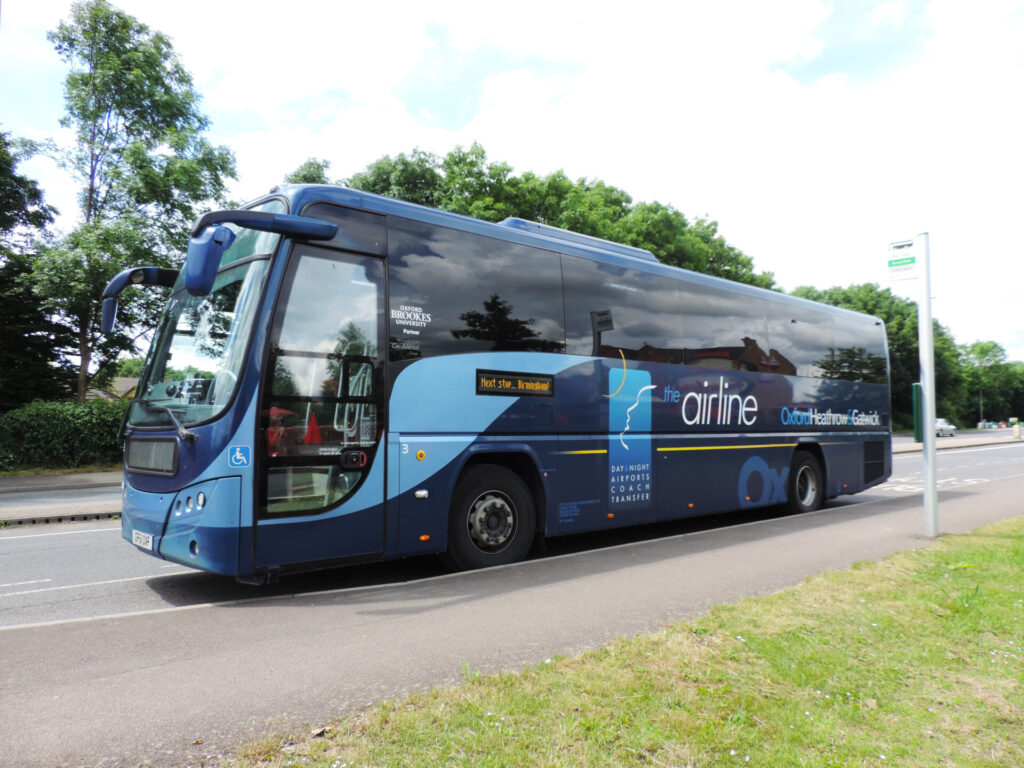
Choosing to take the airline over driving to the airport could be an excellent way of reducing congestion and tackling these issues. If each of our coaches were used to 50% capacity, an estimated 24.7 cars would be removed from the road per coach. Similarly, if used to 100% capacity, over 50 cars would be taken off the road, freeing up 200m of road space per coach.
Economic benefits

Cheaper travel
Bus travel is generally more affordable than driving, especially when considering fuel costs, parking fees, and vehicle maintenance. At Oxford Bus Company, we believe bus and coach travel should remain accessible and affordable. That’s why we offer a variety of tickets that make it easy to do more, see more, and experience more, for less.
Find out more about our tickets here.
Promoting equitable transportation
Bus and coach travel also provides an equitable transportation system which helps increase employment and productivity:
- Buses are important for those trying to re-enter the workforce.
- People use buses to commute to work, where they earn money that they reinvest in the economy.
- Bus and coach companies are a major employer and integral to the economies of the communities in which they operate.
Access to employment
Bus travel is important for those trying to re-enter the workforce: 77% of jobseekers don’t have access to a car, and 40% of unemployed people say a lack of transport has inhibited them from getting a job.
Bus companies also employ thousands of people across the country in a variety of roles.
Explore our job vacancies and careers here.
Social benefits

Community mobility and involvement
Bus and coach travel can improve community mobility by providing direct links to other communities and areas where there are opportunities such as jobs, education, healthcare, shopping, social gatherings, and more. Oxford Bus Company, alongside Thames Travel – our sister company, we operate services to towns and villages across Oxfordshire, including Abingdon, Didcot, Wallingford, and Watlington as well as Heathrow and Gatwick Airports. Plus, our overall involvement in our local community provides us with an opportunity to raise awareness around important and charitable causes, such as through our annual ‘Brand the Bus’ competition.
Explore Oxford Bus Company services here.
Tackling loneliness
Tackling loneliness is important to us, and we are proud of the role we play in connecting people and providing links to education, employment, healthcare, and other social services. Through a series of ‘Chatty Bus’ events, Oxford Bus Company has demonstrated the important – but frequently overlooked – role that buses can have in battling loneliness among people in our community.
Health & wellbeing benefits
There are also many health and wellbeing benefits to bus and coach travel:
- Bus services provide a highly accessible link to healthcare and health centres.
- According to a study published in the Journal of Preventative Medicine, commuters reported better psychological wellbeing after travelling by public transport compared to driving.
- Walking to and from the bus stop can be an effective way to get active and reach your daily step goal. In fact, research suggests commuters who walk to the bus stop tend to have less body fat than those who drive the whole way to work.